
DIGITAL@EXXARO BRINGS SMART CONTROL AND DRONES TO EXXARO
Digital@Exxaro (D@E) is all about using digital technology to improve productivity, efficiency and workplace safety, while generating value for Exxaro through the use of modern digital technologies and techniques.
Thickener Smart Control boosts beneficiation @Belfast Mine
Belfast Mine, like many mines in the Mpumalanga area, struggles with build-up in its ultra-fines circuit, which can lead to its Beneficiation Plant being shut down. That’s why, when it learned of the Thickener Smart Control technology, it saw an opportunity to improve the design of its Beneficiation Plant and improve overall productivity.
What is the key challenge at Belfast?
When treating Run of Mine (ROM) that is weathered or contains an excessive percentage of ultra-fines, the thickener becomes overloaded with material, forcing the Beneficiation Plant to be stopped until the ultra-fines circuit is cleared of all build-up. This can take between eight and 12 hours.
Did you know:
The average standing times in most of
the Mpumalanga operations can be as
high as 48 hours per month.
What is Thickener Smart Control?
Thickener Smart Control reviews the ultra-fines circuit design and operating philosophy, to influence the operation of the thickener.

Key benefits include:
Increase in plant utilisation through optimised ROM throughput.
Increased Product Tonnage because of optimised plant utilisation and ROM throughput.
Increase Net Operating Profit.
Reduction of downtime caused by the ultra-fines circuit being overloaded.
Optimising the throughput to prevent stoppage due overloading.
What is the future of Thickener Smart Control?
The Thickener Smart Control will remain with us, although its form may be adapted to improvements in our understanding of geometallurgy, materials, instrumentation and rheology. Even though there is a trend to augment the thickener with a filter for dry stacked tailings disposal, the thickener remains a practical and essential part of the flowsheet before the filter.
Exxaro moves into Phase two of its drone strategy
Drones, or Remotely Piloted Aircraft Systems (RPAS), are fast becoming a mainstream addition to conducting surveys and mapping. And this is only the beginning.
What advantages do drones have over conventional terrestrial equipment?
- Drones offer a safer, faster, more accurate and cost-effective option for most mapping and surveys applications.
- Drones enable businesses to remotely survey inhospitable and risky areas.
- Drones enhance workplace safety by removing personnel from direct exposure to hazards.
What is Exxaro’s RPAS strategy?
In 2017, Exxaro embarked on its three-phased approach to introduce and embed RPAS. Phase one was outsourced and has since been completed and we are currently in Phase two. In this phase Business Units will train personnel to operate under the supervision and statutory certificate of a third-party vendor. The third phase will ensure that Exxaro obtains its own corporate RPAS Operating Certificate and no longer requires the services of a third party.
Are any Exxaro teams using drone technology?
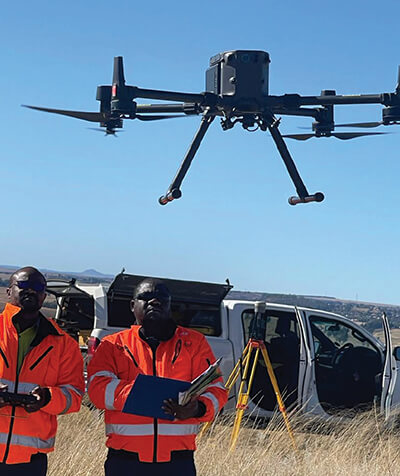
The Corporate Survey team who obtained their RPAS Licenses and completed all associated practical training are now actively using multi-rotor RPAS. They have performed successful maiden survey exercises at Tshikondeni and Durnacol.
The other Business units are at various stages of implementation and training. Grootegeluk is making impressive progress. They are pioneering the use of a newly introduced vertical takeoff-and-landing [VTOL] unit that has reduced flight time of a specific area from about five hours to one hour.
What were the outcomes of the Durnacol exercise?
The team used RPAS to cover the entire dump area (over 81 Ha). The one-hour flight time generated a point cloud density in excess of 100 points per m². In the past, due to the rough nature of the terrain, this exercise was done by manually traversing the area with a GPS Rover at a 10m grid spacing. This took over a month and all inhospitable and inaccessible areas were forfeited. In addition, the GPS exercise only generated one per 100m².
How can drones benefit Exxaro in the future?
Once the strategy is fully embedded, the applications will be wide ranging and will include:
- Standard survey mapping.
- Topographical surveys.
- Subsidence monitoring.
- Highwall mapping.
- Blast fragmentation monitoring.
- Infrastructure integrity surveys.
<
>